Executive Summary
Tinnitus is one of the most common and least understood companions of traumatic brain injury. It rarely appears on a scan. It rarely resolves on a predictable schedule. And like the fatigue described in Paper 1 of this series The Fluctuating Energy Economy of Brain Injury, it is frequently minimized by systems built around a static, structural model of brain injury rather than a dynamic, metabolic one.
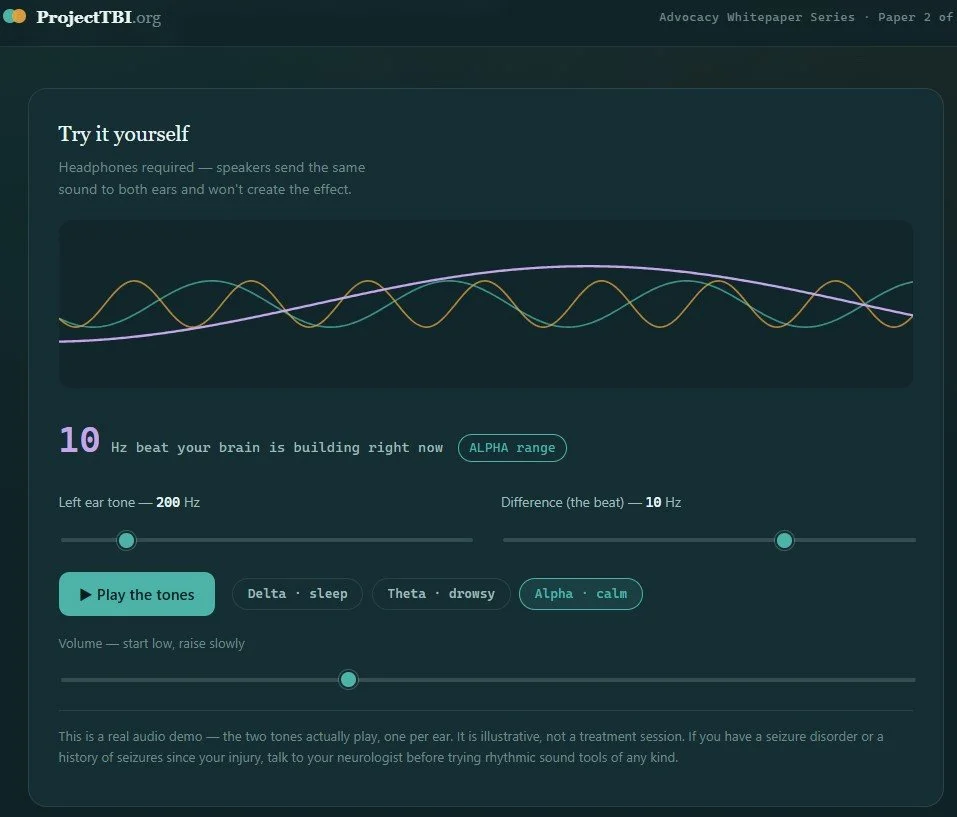
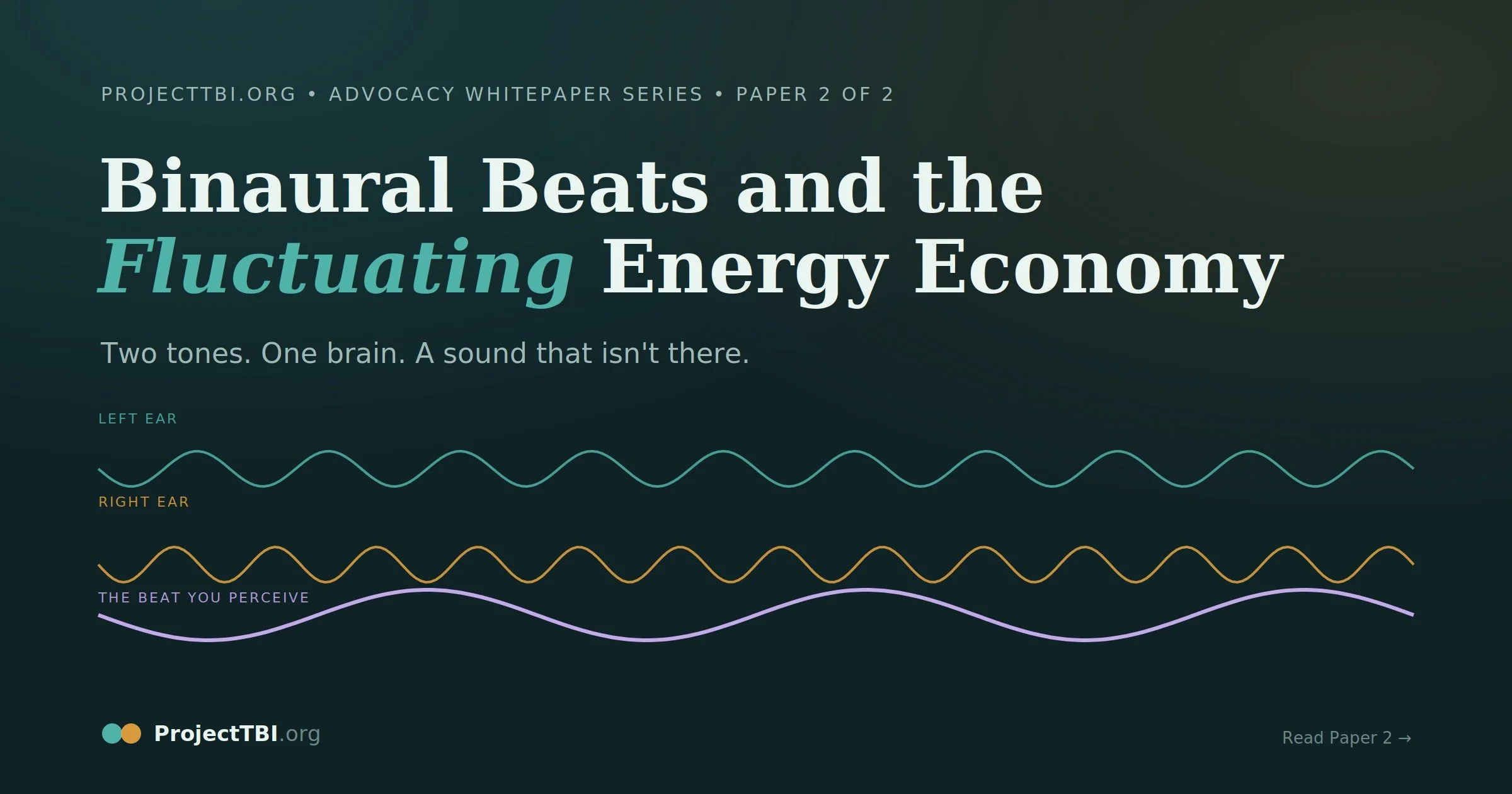
This paper examines binaural beats*, a noninvasive auditory technique in which two slightly different tones, delivered separately to each ear through headphones, produce the perception of a third, internally generated “beat.” Binaural beats have been studied, in small and preliminary trials, as a tool for tinnitus management and, more broadly, as a low-risk auditory input that may support relaxation, sleep, and autonomic regulation in people recovering from traumatic brain injury.
I want to be direct about the state of the evidence, in the same spirit that governed Paper 1: this paper does not overstate what is known. Binaural beats are not a cure for tinnitus. They are not a treatment for the structural consequences of TBI.
What the research does suggest, cautiously, is that binaural beats may help some survivors shift their relationship to two of the most exhausting features of chronic brain injury: a phantom sound that will not stop, and a nervous system that has forgotten how to power down. Both of those features draw directly from the same limited account this series calls the Fluctuating Energy Economy.¹
“Binaural beats are not a cure for tinnitus. What the evidence suggests, cautiously, is a shift in how much a phantom sound is allowed to cost.”
This paper is written for the same four audiences as Paper 1: survivors and families looking for accessible tools that will not make things worse; clinicians who need an honest summary of a modality patients are already trying, with or without guidance; policymakers and disability systems evaluating what counts as legitimate rehabilitative support; and the public, whose understanding of “alternative” interventions is too often shaped by either dismissal or hype, and rarely by the evidence itself.
Try The app: https://velvety-dieffenbachia-7d606a.netlify.app/