
A Concussion Is Not Just an Injury — It Can Be a Reboot
One of the strangest things about traumatic brain injury is that it doesn’t just affect your memory, attention, or ability to find the right word. It can affect your sense of who you are.
I hear versions of the same sentence from survivors all the time: “I’m still me. I just don’t feel like the same me.”
That is incredibly difficult to explain to someone who hasn’t experienced it. Medicine can explain a lot about what happens after a concussion or TBI. We can talk about disrupted brain networks, inflammation, neurotransmitters, fatigue, and neuroplasticity. All of that matters. But none of it completely describes what it actually feels like to live inside an injured brain.
The best analogy I have found is a computer.
Maybe the hardware isn’t destroyed. Maybe the operating system got knocked sideways.
And now it is rebooting.
The Ego Is an Operating System
Think about everything that went into creating the person you were before your injury. Your parents, childhood, where you grew up, the language you learned, school, friends, work, relationships, successes, failures, trauma, culture, television, social media — all of it.
From the time we are born, our brains are constantly being programmed by the world around us. Eventually that programming becomes so familiar that we stop recognizing it as programming. We simply call it me.
If you stay with the computer analogy, education installs updates. Experience adds programs. Habits create shortcuts. Trauma can rewrite entire sections of code. Over decades, that operating system becomes incredibly complicated, and eventually we assume the operating system is the person.
I’m not sure it is.
There Is Something Underneath All of That
This is where things get harder to explain.
Under the words, memories, habits, opinions, accomplishments, and stories we tell about ourselves, there seems to be something simpler. Awareness. Presence. Being. Call it whatever makes sense to you.
In computer terms, I think of it almost like the BIOS — something deeper than the operating system. It doesn't require the perfect word. It doesn't require you to remember what you walked into the kitchen for. It doesn't disappear because you can't follow a conversation in a noisy restaurant.
It is simply you being there.
Writers like Eckhart Tolle have described something similar as presence. But I think TBI survivors sometimes say it better:
“My brain isn't working right, but I'm still in here.”
Think about how powerful that sentence actually is.
Then the Injury Happens
A concussion or TBI can suddenly interfere with the systems we have spent a lifetime depending on. Words slow down. Attention becomes unreliable. Memories become harder to access. Emotions can change. Noise becomes overwhelming. Light can become exhausting. The connection between what you are thinking and what you are able to say can suddenly feel broken.
And that is terrifying because most of us have spent our entire lives believing that our thoughts, memories, abilities, and productivity are who we are.
Then brain injury comes along and starts taking some of those things offline.
But something interesting can happen in the middle of all that confusion.
You realize you are still there.
The Reboot
That is why I keep coming back to the idea of a reboot.
I’m not suggesting that a concussion literally wipes your operating system clean, and I’m certainly not suggesting that brain injury is somehow a gift. It can be devastating.
But for some of us, the experience feels like the connection between our old programming and our deeper sense of self has been interrupted.
During recovery, the brain is adapting. Connections are changing. Old ways of doing things may no longer work. Things we barely noticed before — light, noise, conversation, emotion, fatigue — can suddenly become impossible to ignore.
You start paying attention because your brain gives you no choice.
And somewhere in that process, some survivors begin questioning things that had been automatic for decades. What actually matters to me? Why was I doing that? Why was I pushing myself so hard? How much of the person I thought I was came from what other people expected me to be?
That is where the reboot analogy becomes interesting.
Maybe recovery isn't simply about getting the old operating system running exactly the way it did before.
Maybe some of it is deciding what gets reinstalled.
Recovery Is More Than Restoration
Traditional rehabilitation understandably focuses on restoring function. Memory matters. Attention matters. Speech matters. Executive function matters. Being able to work, drive, read, communicate, and participate in your family again matters enormously.
But I have come to believe recovery can involve something else too.
It can involve figuring out who you are when some of the things you once used to define yourself aren't as reliable anymore.
That doesn't minimize the injury. It doesn't romanticize TBI. I wouldn't wish this experience on anybody.
It simply acknowledges something I think a lot of survivors understand long before they have the words to describe it:
Even when the operating system is struggling, the person is still there.
And maybe recovery isn't entirely about becoming the person you were before the injury.
Maybe part of recovery is meeting the person who is still there underneath all of it.
Why This Matters
At ProjectTBI.org, one of the things I want to do is capture these experiences because recovery is not only neurological. It is personal. It is emotional. And sometimes it reaches all the way down to identity.
We need the medical research. We need neurologists, therapists, neuropsychologists, speech therapists, occupational therapists, and rehabilitation programs.
But we also need the people who have actually lived it.
Because if enough survivors independently describe this feeling of losing access to pieces of themselves while somehow knowing that they are still in there, I don't think we should dismiss that experience simply because it is difficult to measure.
Those stories matter.
They may even be data.
And maybe hearing them will help the next person sitting alone after a brain injury, wondering why they don't recognize the person they used to be.
You are still in there.
Your brain may be healing, adapting, and reorganizing.
And sometimes, somewhere in that process, you may discover parts of yourself that were there all along.
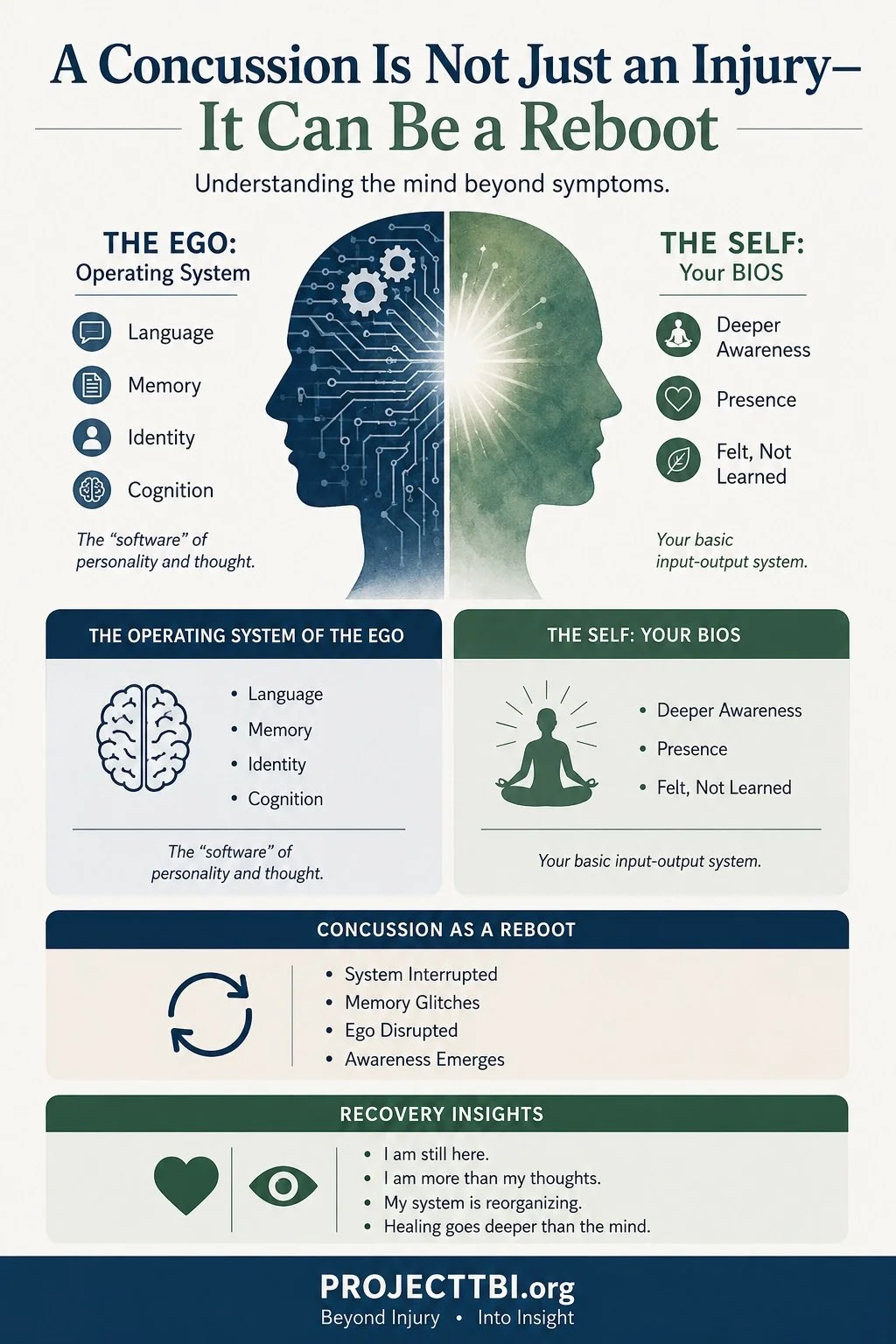
You are not disappearing.
Your system is reorganizing.
And sometimes, in that process, people discover parts of themselves they never noticed before the injury.