
The Fluctuating Energy Economy of Brain Injury
One of the questions I hear most often from brain injury survivors is deceptively simple: "Why can I do something today that I can't do tomorrow?"
It's a question I've asked myself countless times.
Since my own injury, I've experienced days when Ialmost felt like the person I used to be. I could write, hold conversations, solve problems, and make plans. Then, sometimes with no obvious warning, the next day would arrive and those same tasks would feel impossibly difficult. Words would come slower. Noise would become overwhelming. My ability to think clearly would seem to disappear as quickly as it had arrived.
To the outside world, this inconsistency can be confusing. Friends, family members, employers, and even medical professionals often assume that recovery follows a straight line. If you were able to do something yesterday, surely you should be able to do it again today. If you look healthy, you must be healthy. If your MRI is normal, your struggles must be exaggerated.
But what if the problem isn't a lack of effort? What if the underlying model of brain injury is wrong?
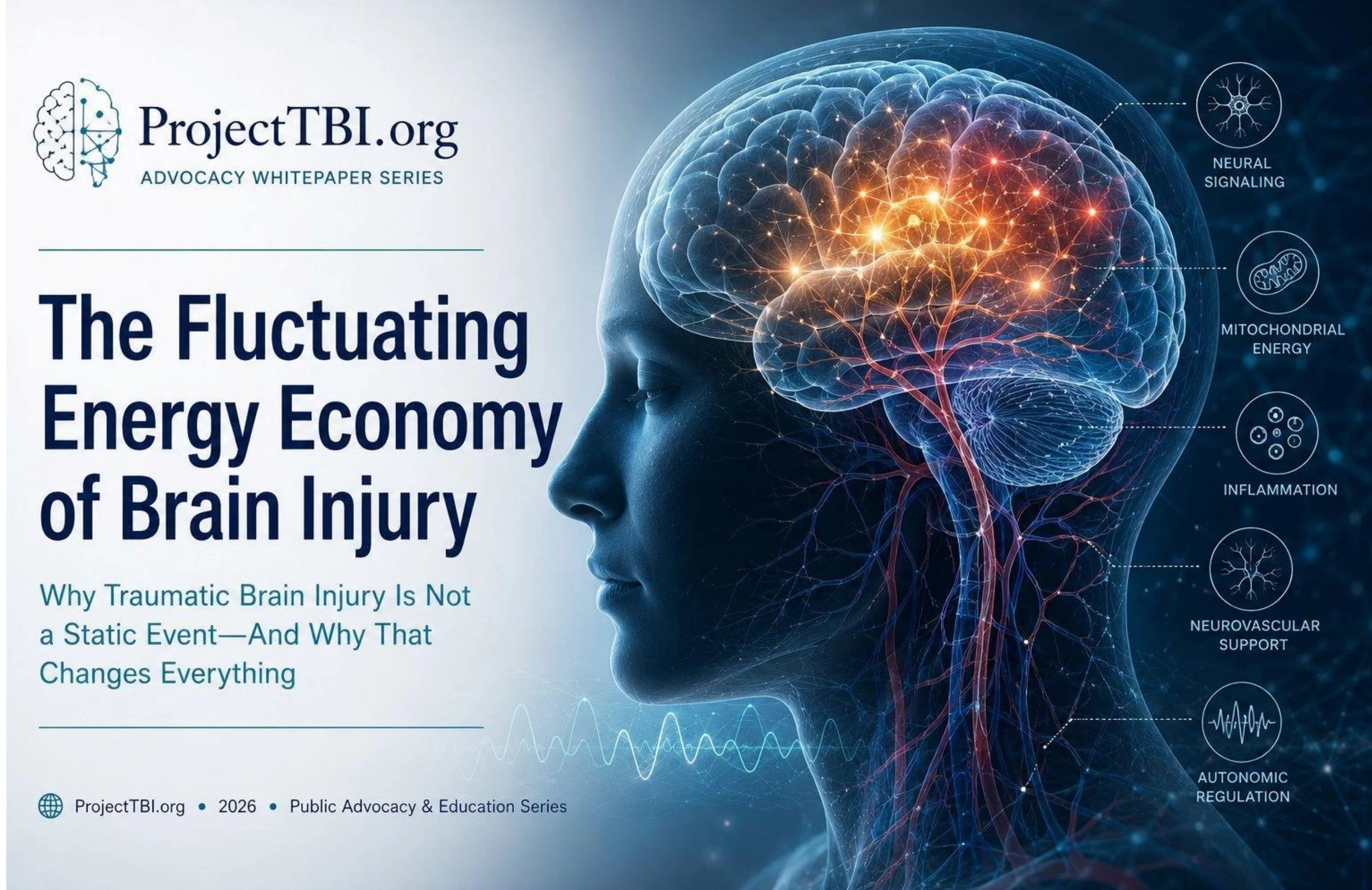
That question became the foundation for our latest ProjectTBI.org white paper, The Fluctuating Energy Economy of Brain Injury. Drawing from current neuroscience, clinical research, and the lived experiences of survivors, the paper explores a different way of understanding traumatic brain injury. Instead of viewing TBI as a single event followed by a predictable recovery, it examines the possibility that many survivors are living with a chronic disruption of the brain's energy systems. Capacity fluctuates. Performance varies. Recovery is often non-linear.
For many survivors, this framework immediately feels familiar. It helps explain why a successful day can be followed by a debilitating crash. It explains why pushing through often comes with consequences that arrive hours later or the next day. Most importantly, it provides a language for experiences that millions of survivors have struggled to describe.
My hope is that this paper helps bridge the gap between what survivors live and what the world believes about brain injury. Better language leads to better understanding. Better understanding leads to better care, better accommodations, and ultimately better outcomes.
If you've ever wondered why brain injury recovery can feel so unpredictable, I invite you to download and read the full paper. The conversation around TBI needs a more accurate model, and perhaps this is one step toward building it.
— Tony Falsone
Founder, ProjectTBI.org