
Prepared Patient Paradox and Brain Injury | Project TBI
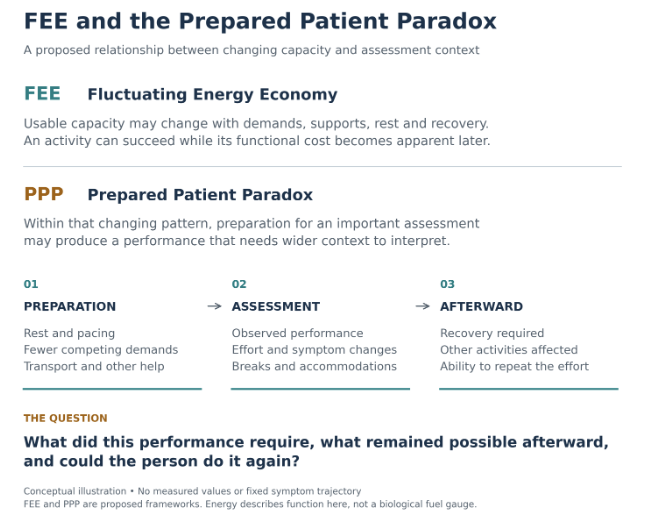
If I have an important appointment tomorrow, I’m probably saving some brain for it today. I rest, keep things quiet, clear my schedule, and sometimes have my wife drive. Then I show up talking, joking, and answering questions, which is exactly what I hoped to do. But how much does that good performance tell you about the rest of my life? What did I set aside to make it possible, what can I still do afterward, and could I do it again tomorrow?
That question led me to the Prepared Patient Paradox, a proposed framework connected to my earlier work on the Fluctuating Energy Economy of brain injury. This paper brings my experience together with existing research to explore whether getting better at managing an injury can sometimes make its limitations harder to see. It’s written for survivors, caregivers, and clinicians, with one practical question running through it: what did this performance require?That question led me to the Prepared Patient Paradox, a proposed framework connected to my earlier work on the Fluctuating Energy Economy of brain injury. This paper brings my experience together with existing research to explore whether getting better at managing an injury can sometimes make its limitations harder to see. It’s written for survivors, caregivers, and clinicians, with one practical question running through it: what did this performance require?
The Prepared Patient Paradox
How preparation for brain injury assessments may obscure everyday limitations
Anthony J. Falsone | September 14, 2026
Public Advocacy and Education Series | Paper 2
A person can perform well during a brain injury assessment and still struggle to sustain that performance in everyday life. This paper asks whether the rest, pacing, and support used to prepare for an important appointment can make those limitations harder to see. It is written for survivors and caregivers, with a research question for clinicians: what did the performance require, and can the person repeat it? The Prepared Patient Paradox is a proposed framework, not an established clinical finding.
The idea
I think we may be accidentally getting too good at being tested. That sounds ridiculous at first, but stay with me. If I have an important neurological appointment Thursday morning, my preparation does not begin when I walk into the doctor's office. It probably started sometime Wednesday. I may take it easier that evening. I'll try to get a decent night's sleep. I'll make sure I eat and hydrate in the morning. I probably won't schedule errands before I leave. Depending on the appointment, I may have somebody else drive.
None of this feels remarkable anymore. Somewhere along the way, living with a brain injury taught me that if something really matters tomorrow, I need to save some brain for it today. That is actually a good thing. One of the things many of us eventually learn after a TBI is how to manage what we have. A loud restaurant can cost us something. Driving can cost us something. A lousy night's sleep can change the next day. A long conversation, a crowded room, a few hours staring at a computer, or simply making too many decisions can quietly eat into whatever capacity we started with. Clinicians have a word for some of this—pacing—but most of us do not need a clinical term to understand it. We have learned what happens when we do not do it.
What happens when the thing I am preparing for is the appointment that is supposed to measure how well my brain works? I know the evaluation matters, so I protect my sleep, eat, hydrate, reduce stimulation, and avoid using up my available capacity before I get there. By the time testing begins, I may be functioning about as well as I can that week.
The test may work exactly as designed. I may genuinely perform well. The clinician is not doing anything wrong, and I am certainly not doing anything wrong. But are we measuring a normal day? The proposed idea is simple: people with fluctuating neurological capacity may prepare for important clinical assessments in ways that temporarily improve their ability to perform. Those strategies are healthy, sensible, and often learned through rehabilitation. But if the preparation is invisible, an assessment may capture the patient's best few hours without capturing what it took to produce those hours, how long they can be sustained, or what happens afterward.
What the appointment may leave unseen
Suppose I sit across from you at 10:00 Thursday morning and have a completely intelligent conversation. I am following everything you are saying. I am finding my words. I am making jokes. Maybe I am even doing pretty well on whatever cognitive tasks you put in front of me. That is real. If I performed well, I performed well.
But that performance tells you what I could do at 10:00 Thursday morning, under those particular conditions. It does not necessarily tell you what happened Wednesday night. It does not tell you whether I cleared my entire morning for this appointment, whether my wife drove, whether I wore earplugs on the way there, whether I avoided a crowded restaurant the night before, or whether I slept nine hours because I knew I needed everything I had for this particular morning.
More importantly, it does not tell you what happens next. Maybe I leave the appointment, grab lunch, and go about my day. If that is what happens, that is useful information. But maybe I get into the passenger seat, close my eyes, and barely speak on the ride home. Maybe the tinnitus is screaming by then. Maybe the headache shows up an hour later. Maybe I sleep for three hours. Maybe dinner, errands, and everything else we intended to do that afternoon are suddenly gone.
Those outcomes describe two very different levels of everyday function, even if the performance inside the testing room looked exactly the same.
We may be saving the battery for the test and then using the test to decide how good the battery is. The battery is a metaphor for usable capacity, not a measurement of brain energy. The question is whether the conditions that made a good performance possible are visible when that performance is interpreted.
The same performance can have different consequences depending on what was required before it and what remains possible afterward. Looking before, during, and after an assessment describes periods to observe, not a predicted symptom trajectory.
Capacity and the demands of ordinary life
There is already useful language for part of this problem. The World Health Organization's International Classification of Functioning, Disability and Health distinguishes capacity from performance. In plain English, capacity concerns what a person can do in a standardized setting; performance concerns what that person actually does in the environment where life happens. [1]
That distinction matters here because a clinical assessment can legitimately show that a person is capable of doing something without establishing that the person can do it repeatedly, under ordinary environmental demands, and still function afterward.
The Prepared Patient Paradox adds another question: what if even the capacity observed in the standardized setting depends partly on what happened before the measurement?
That is where I think we need the idea of sustainable capacity. Capacity asks whether I can do something. Sustainable capacity asks whether I can keep doing it, repeat it when necessary, absorb the normal demands around it, and still function afterward. Sustainable capacity is used here as a practical descriptive term, not an additional official ICF qualifier or a validated clinical score.
Most jobs do not require us to perform brilliantly for ninety minutes after spending the previous day preparing for them. They require us to show up Monday morning, function for most of the day, go home, live some kind of life, sleep, and come back Tuesday to do it again. Parenting works the same way. So does school. So does running a household. So does just being a person. Being able to do something once matters. Being able to live that way matters too.
Accumulated demand changes the picture
Since my injury, I have become interested in how much life has happened before the moment we are looking at. Driving, conversation, screens, noise, and decisions can leave me with less available capacity. An enjoyable activity can do that too. The person you meet after rest may function differently from the person you meet after several hours of ordinary demands.
This connects directly to something Project TBI has previously called the Fluctuating Energy Economy, or FEE. FEE is a proposed functional model for the frustrating reality that usable capacity after brain injury may not be stable. Some days we have more. Some days we have less. Within the same day, successful activity can carry a cost that does not become obvious until later.
FEE uses the language of expenditure and recovery to describe lived function. It does not claim that every symptom has one cause or that usable capacity can be read from a literal fuel gauge. Sleep, pain, mood, medications, sensory conditions, and other factors may also change how a person functions. Its usefulness depends on whether it helps us describe and investigate patterns more accurately.
Performance and the cost of performance are two different measurements. I can successfully spend $100. That does not tell you whether I have $100,000 in the bank or whether I just spent my last hundred bucks. The transaction looks exactly the same. The consequences do not.
How FEE and PPP relate
FEE describes the wider pattern of changing usable capacity. PPP focuses on whether preparation around an assessment changes what the observed performance tells us about sustainable everyday function.
Figure 2. Proposed relationship between FEE and PPP. The sequence identifies periods to observe; it does not predict that preparation always improves performance or that an assessment will be followed by a crash.
Preparation and successful adaptation
We usually treat preparation as something outside the measurement. The patient slept well. The spouse drove. The morning was cleared. The headphones were used. The patient rested before leaving. Those facts can sound like background details. But in a condition defined partly by fluctuating function, perhaps the preparation belongs inside the measurement.
If a person has to rearrange the previous twelve or twenty-four hours to produce three good hours, that rearrangement tells us something about the capacity being measured. If driving to the assessment would use too much of the resource needed to complete the assessment, having somebody else drive is not meaningless simply because the strategy worked. If avoiding noise allows the person to perform better, the quiet is not proof that noise no longer matters.
Rehabilitation teaches us to compensate. We learn pacing, protect sleep, use written reminders, and arrange quieter environments or transportation help. Those are successes. But when the strategies work, the effort and support behind the performance may become less visible. A patient who allocates limited capacity carefully may look as though the limitation is gone.
Structure can make limitations less visible
My Army experience gives me another way to think about this. There were demands to keep going, but there were also schedules, assigned responsibilities, and periods when the structure told us what to do next or when to stop. Civilian life does not automatically provide that structure. This is not a claim that military service consistently protects sleep or prevents fatigue. It is an observation about how external organization can affect what someone manages to accomplish.
Rehabilitation can help civilians build structure too. During intensive outpatient therapyᵃ, my days included scheduled therapies and downtime. A routine can help someone function more consistently, but the routine itself may be part of the support they need. PPP asks whether an assessment records that dependence on preparation and support when the resulting performance looks good. The contribution of military habits or rehabilitation training would need to be studied rather than assumed.
My disability assessment
I prepared for an earlier disability assessment because I wanted to give it everything I had. The initial outcome did not recognize the extent of my limitations. Later, after records from intensive outpatient therapy became part of the picture, the outcome changed. That sequence made me wonder whether an assessment could see the version of me I had prepared to bring into the room while missing more of my ordinary limitations. I cannot establish that preparation caused the initial outcome, or isolate which records determined the later decision. This is the experience that helped raise the question, not evidence that answers it.
What caregivers see and what testing measures
A clinician sees the assessment. A caregiver may also see the preparation, the ride home, and the activities that become possible or impossible afterward. They may know that responsibilities were handed off to protect the appointment. They may watch us speak clearly in the room and then struggle to follow another conversation on the way home. Both observations can be accurate.
Caregiver observations do not replace neuropsychological testing and caregivers should not be expected to diagnose what they are seeing. But they can provide something a standardized test has difficulty providing on its own: context around the performance.
For a condition that can fluctuate with time and accumulated demand, context may not be a side note. It may be part of what we are trying to understand.
With the patient’s agreement, a caregiver can describe what they directly observed, including days when recovery was quick and plans continued normally. Differences between the patient’s account and the caregiver’s account should be explored rather than treated as proof that one is wrong.
A good score does not measure every cost
Neuropsychological assessments can tell us important things about attention, memory, processing speed, executive function, and other cognitive abilities.
A test can accurately measure what it was designed to measure and still leave another important question unanswered.
Two people can complete the same task equally well and need very different recovery afterward. The result measures their success on that task. It does not, by itself, establish how often they can repeat it or what other responsibilities they can sustain around it.
Cognitive fatigue concerns the person’s experience of mental exhaustion. Cognitive fatigability concerns measurable changes in performance as effort continues. A small study of people with persistent fatigue after mild TBI found slower responses and increased response variability during a vigilance task, together with differences in neural activity. These are related measures, but they are not interchangeable. [2]
That matters because we should not assume that a stable score means the task carried a stable cost. Sometimes the injured brain may maintain output by working harder to produce it. The answer can still be correct while the effort required to produce the answer is changing.
That possibility fits the central concern of the Prepared Patient Paradox. If we record only whether the answer was correct, we may miss the rising effort required to keep producing correct answers—and we may miss what happens after the effort can no longer be sustained.
PPP does not presume that clinicians ignore fatigue or that every assessment is brief. Longer evaluations, behavioral observations, functional history, and collateral information may already address parts of this problem. The proposed question is whether preparation and recovery add useful information beyond those existing practices.
What the evidence supports
The surrounding research makes this a reasonable question to investigate. It does not establish that preparing for an appointment causes disability to be underestimated.
Juengst and colleagues followed 18 adults with chronic TBI using daily smartphone reports over eight weeks. Fatigue and emotional symptoms varied within individuals over time. This was a small pilot study of self-reported symptoms, not a study of assessment preparation or proof that symptoms track cognitive test scores. It supports looking beyond a single observation. [3]
The vigilance study discussed earlier supports examining sustained effort and measurable fatigability. It did not test whether pre-assessment pacing changes clinical interpretations. A performance score and an account of fatigue can each contribute information without one automatically validating or invalidating the other. [2]
The ICF already distinguishes standardized capacity from function in a person’s current environment. PPP focuses on an additional practical question: whether preparation before the standardized observation affects how representative that observation is of sustainable everyday function. [1]
Where PPP fits with existing ideas
The idea that a good result can conceal additional effort is already present in research. Hockey’s compensatory control framework describes how people may protect performance under stress or high workload by changing how they allocate effort, with costs beyond the main task. This is an important predecessor to PPP, rather than a finding introduced by this paper. [5]
Ziino and Ponsford studied 46 people with TBI and 46 controls during a 45-minute vigilance task. Performance in the TBI group was generally stable over time, although at a lower overall level, while other measures suggested greater cost in maintaining it. The authors interpreted their findings as support for a coping hypothesis of fatigue. This brings the distinction between performance and its cost directly into TBI research, but does not establish what preparation before a clinical assessment changes. [6]
The gap between structured testing and everyday demands also has a long history. Shallice and Burgess described three people with traumatic frontal injuries who struggled with open-ended tasks involving several goals despite good performance on some conventional tests. Their study concerned strategy use and intentions, rather than fatigue or appointment preparation. It helps explain why the structure of an assessment matters without making every mismatch an example of PPP. [7]
FEE’s energy language also needs to leave room for competing explanations. Kurzban and colleagues proposed that subjective effort can reflect the opportunity costs of allocating cognitive processes among competing activities, rather than depletion of a single fuel supply. That theory does not settle the causes of fatigue after TBI. It is another reason to treat FEE as a description of lived function and test its patterns without assuming one mechanism. [8]
Clinical guidance already recognizes cognitive fatigue and the need to account for it during neuropsychological testing, including appropriate breaks. PPP therefore asks a narrower question: does deliberate conservation before the appointment, considered together with recovery afterward, provide useful information about ordinary function beyond the tests, history, and accommodations already used? This paper proposes that question; it does not claim the underlying concerns are new or that present assessments routinely ignore them. [9]
The white coat analogy
The white-coat effect is a familiar example of measurement changing with context. Clinic blood pressure can differ from readings obtained elsewhere; an accurate reading in one setting need not describe the person’s usual state. [4] PPP asks whether anticipation of an appointment can lead to preparation that changes the functional state measured there. This is an analogy about context, not evidence of a shared biological mechanism.
The limits of the proposal
PPP may describe only some people, some conditions, or some assessments. Preparation may improve the accuracy of testing by reducing avoidable interference. Anxiety, poor sleep, travel, or pain may instead make someone perform worse at an appointment. Some people will show little difference. A useful study must allow all of those outcomes and determine whether the proposed pattern adds anything to existing explanations.
Similar questions might be asked about other conditions involving fluctuating function, including symptoms during menopause or recovery after coma. Findings in TBI cannot simply be transferred to those populations. CTE also has distinct diagnostic questions that this paper does not address. Any extension would require condition-specific evidence.
Widening the assessment window
A practical starting point is to describe the period around the assessment. Continue the usual care and follow the clinician’s instructions; there is no reason to arrive deliberately exhausted or remove helpful supports to make a limitation visible. Recording what made the appointment possible is more useful than trying to create a worse performance.
Before the appointment, a survivor or caregiver could briefly record sleep, any deliberate reduction in activity, travel arrangements, and responsibilities handed off. During the appointment, useful context might include breaks, accommodations, symptom changes, and increasing difficulty following instructions. Afterward, record recovery time and which planned activities continued or changed, including the following morning when relevant. The record should include ordinary or good outcomes as well as difficult ones.
This need not become another exhausting assignment. A few sentences, a voice note, or an account given to the clinician may be enough to start a conversation. There is no preferred outcome and no requirement to demonstrate a crash. The purpose is to describe function more completely.
How researchers could test the proposal
A first study could document what patients actually do before assessments and compare it with their own ordinary routines. Repeated observations on ordinary days would establish each person’s range. Around the assessment, the same measures could capture the preceding day, testing, recovery later that day, and the next morning. Useful measures would distinguish subjective symptoms, observed function, test performance, and recovery time.
The central prediction is that greater deliberate conservation may be associated with better function on arrival relative to the person’s usual range, while the surrounding demands and recovery reveal limitations that the scores alone do not show. Observational associations would not prove causation. Injury severity, baseline disability, sleep, pain, mood, medication timing, support, appointment demands, and practice effects could influence the pattern. People with greater limitations may also prepare more, making that relationship especially important to examine.
Researchers could then test whether preparation and recovery information improves prediction of everyday function beyond standard assessment and history. Lack of a meaningful association, or no improvement in prediction, would weaken PPP’s usefulness as a distinct framework. Studies should preserve normal care and accommodations rather than require unsafe exhaustion.
The question I want on the table is straightforward: what did this performance require, what remained possible afterward, and could the person do it again tomorrow? A good assessment result deserves to be recognized. Understanding the life around that result may help us interpret what it means.
Plain English glossary
Capacity: What a person can do under defined or standardized conditions at a particular moment.
Cognitive fatigue: Mental exhaustion that can make thinking, concentrating, remembering, communicating, or processing information more difficult.
Cognitive fatigability: Measurable change in cognitive performance as a task continues. It is related to, but not identical with, how fatigued a person feels.
Compensatory strategy: Something a person uses to work around a limitation, such as calendars, alarms, written notes, quiet environments, headphones, scheduled breaks, or transportation help.
Ecological validity: Medical and research language for a simple question: does what happens on this test tell us something useful about what happens in real life?
Fluctuating Energy Economy or FEE: Project TBI’s proposed descriptive framework for changing usable capacity, accumulated demands, and recovery after brain injury. Energy is used as a metaphor for function rather than a measured biological quantity.
Performance: In the WHO ICF framework, what a person actually does in their current real-life environment.
Pacing: Balancing activity and rest in an effort to use available capacity more sustainably and avoid repeatedly exceeding one's limits.
Prepared Patient Paradox: A proposed framework in which adaptive preparation before an important assessment may temporarily optimize performance and make a narrow clinical snapshot less representative of ordinary sustainable capacity.
Sustainable capacity: What someone can reasonably and repeatedly do over time, including the surrounding demands and recovery required, rather than what they can accomplish once under favorable conditions. This paper uses it descriptively rather than as an official ICF qualifier.
White-coat effect: A context-dependent difference in blood pressure associated with the clinic setting. It is used here only as an analogy for the broader principle that measurement context can influence the measurement.
References
[1] World Health Organization. International Classification of Functioning, Disability and Health. Activities and Participation qualifiers. Capacity and performance definitions. WHO ICF definitions.
[2] Möller, M. C., et al. (2017). Fatigue and cognitive fatigability in mild traumatic brain injury are correlated with altered neural activity during vigilance test performance. Frontiers in Neurology, 8, 496. doi:10.3389/fneur.2017.00496.
[3] Juengst, S. B., et al. (2019). Variability in daily self-reported emotional symptoms and fatigue measured over eight weeks in community dwelling individuals with traumatic brain injury. Brain Injury, 33(5), 567–573. doi:10.1080/02699052.2019.1584333.
[4] Pickering, T. G., Gerin, W., & Schwartz, A. R. (2002). What is the white-coat effect and how should it be measured? Blood Pressure Monitoring, 7(6), 293–300. doi:10.1097/00126097-200212000-00001. PubMed record.
[5] Hockey, G. R. J. (1997). Compensatory control in the regulation of human performance under stress and high workload; a cognitive-energetical framework. Biological Psychology, 45(1–3), 73–93. doi:10.1016/S0301-0511(96)05223-4.
[6] Ziino, C., & Ponsford, J. (2006). Vigilance and fatigue following traumatic brain injury. Journal of the International Neuropsychological Society, 12(1), 100–110. doi:10.1017/S1355617706060139.
[7] Shallice, T., & Burgess, P. W. (1991). Deficits in strategy application following frontal lobe damage in man. Brain, 114(2), 727–741. doi:10.1093/brain/114.2.727.
[8] Kurzban, R., Duckworth, A., Kable, J. W., & Myers, J. (2013). An opportunity cost model of subjective effort and task performance. Behavioral and Brain Sciences, 36(6), 661–679. doi:10.1017/S0140525X12003196.
[9] State Insurance Regulatory Authority, New South Wales. Neuropsychological assessment of children and adults with traumatic brain injury: Guidelines. Guidance on cognitive fatigue and rest breaks. Accessed September 14, 2026. SIRA assessment guidelines.
Project TBI note
This is an educational paper based on lived experience and a proposed research framework. It does not establish a diagnosis, determine eligibility for disability benefits, or replace an individualized clinical assessment. The references support surrounding concepts; they do not directly demonstrate the Prepared Patient Paradox. Personal experiences and the proposed study design are identified separately from research findings.
About the author and community
Anthony J. “Tony” Falsone is a U.S. Army veteran who went on to a 20-year career in technology before sustaining a brain injury in civilian life. Through ProjectTBI.com, he brings lived experience into practical education and conversations about life after brain injury. He also serves as a board member at large with Bridging the Gap, a nonprofit community connecting brain injury survivors, caregivers, families, and friends through shared stories, resources, and support.
Appendix Rehabilitation resource
a. MossRehab Institute for Brain Health (MRIBH). Official information about the intensive outpatient rehabilitation program referenced in the author’s story, including care for veterans and first responders with brain injury and related symptoms.
