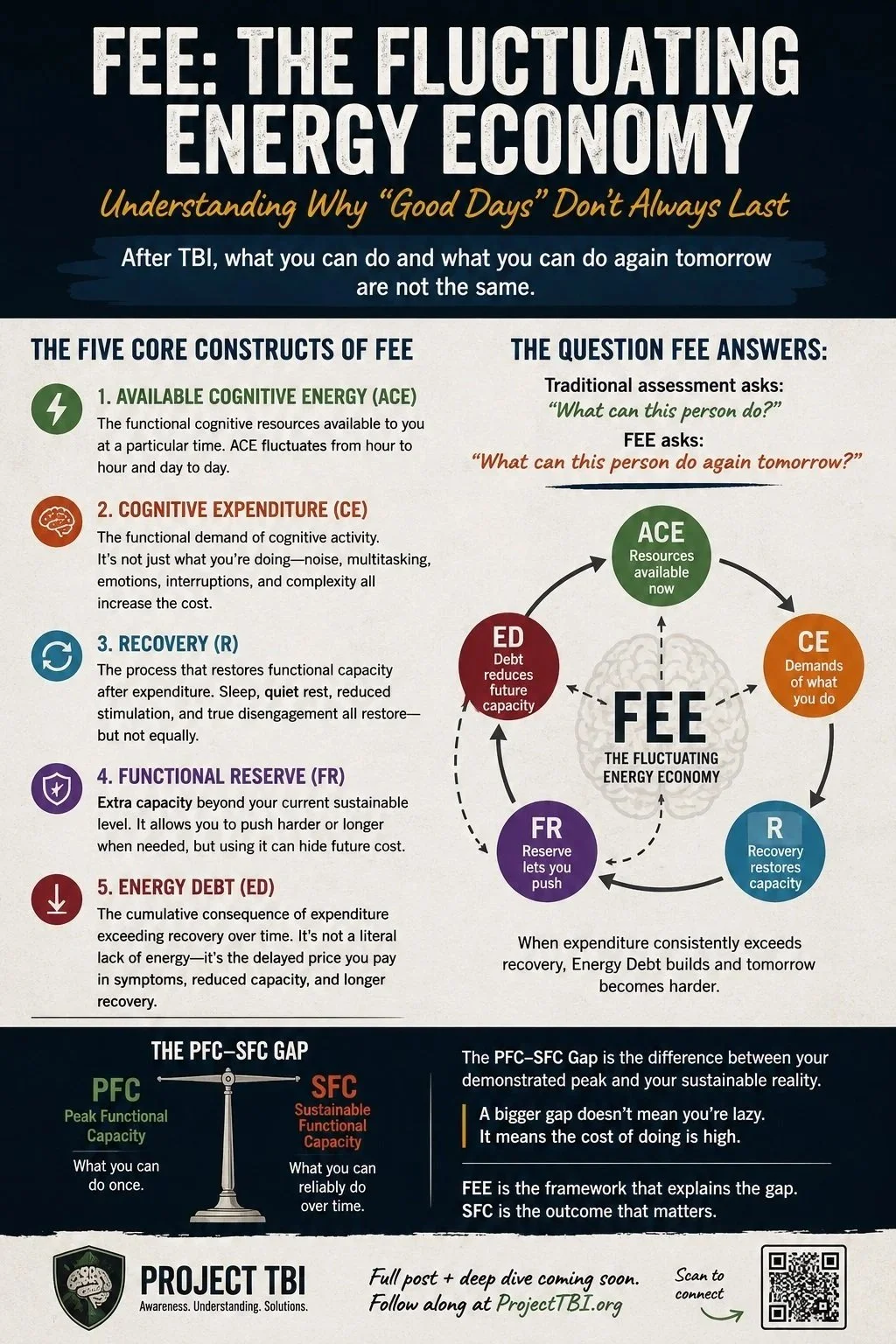
The Fluctuating Energy Economy, or FEE.
It really started because I was trying to understand my own damn brain.
Living with a brain injury I've been trying to reconcile what I know I'm capable of doing with what I'm actually capable of sustaining. I can have a really good day. I can write for hours, work on a project, sit through meetings, solve problems, get a ridiculous amount accomplished and, from the outside looking in, probably appear completely fine.
Then tomorrow comes.
And sometimes the bill shows up.
That eventually made me wonder if we've been asking the wrong question. We tend to look at somebody and ask, “What can this person do?” But after living this for a few years, I'm becoming much more interested in a different question:
“What can this person do again tomorrow?”
That distinction has led us to two concepts we're now developing as part of FEE: Peak Functional Capacity (PFC) and Sustainable Functional Capacity (SFC).
Peak Functional Capacity is essentially what I can demonstrate that I'm capable of doing at a particular point in time. Sustainable Functional Capacity is what I can reliably reproduce over time without causing a disproportionate increase in symptoms, cognitive fatigue, performance problems, or the amount of recovery I need afterward.
And those two things can be very different.
I might be capable of doing four hours of demanding cognitive work today. I know I'm capable of it because I just did it. But if those four hours leave me shot for the rest of the day, require several hours of recovery, or mean that tomorrow I can barely manage two hours, then those four hours don't tell the whole story about my functional capacity.
The distance between those two things is what we're calling the PFC–SFC Gap.
FEE is our attempt to understand what may be happening inside that gap. We're looking at five interacting concepts: the cognitive resources available at a particular time, what an activity actually costs, how effectively someone recovers afterward, the reserve that allows us to temporarily push beyond a sustainable level, and the cumulative consequences when expenditure repeatedly exceeds recovery.
We're calling those Available Cognitive Energy, Cognitive Expenditure, Recovery, Functional Reserve, and Energy Debt.
Energy Debt doesn't mean I think there's literally a fuel gauge in my brain somewhere. These are functional concepts, not claims that we've discovered some new neurological energy source. “Energy Debt” is simply a way of describing something I know very well: sometimes I can borrow from tomorrow to perform today.
And that may be the part of this that matters most to me.
I can do it. You watched me do it. That doesn't necessarily mean I can do it again tomorrow. And it certainly doesn't tell you what it cost me to do it.
That's the idea behind the Fluctuating Energy Economy.
My own experience helped me ask the question. It doesn't prove the answer. That's where we're headed next. We're trying to turn this into a framework that can be challenged, measured, researched and, if we're wrong, proven wrong.
Because if we're right, maybe we need to stop looking only at what someone with a brain injury can accomplish in a particular moment and start paying attention to what they can actually sustain across a life.