Vision Therapy and Prism Glasses After Brain Injury: When Your Eyes Aren’t the Whole Problem
One of the confusing things about brain injury is that you can have 20/20 eyesight and still have significant problems seeing.
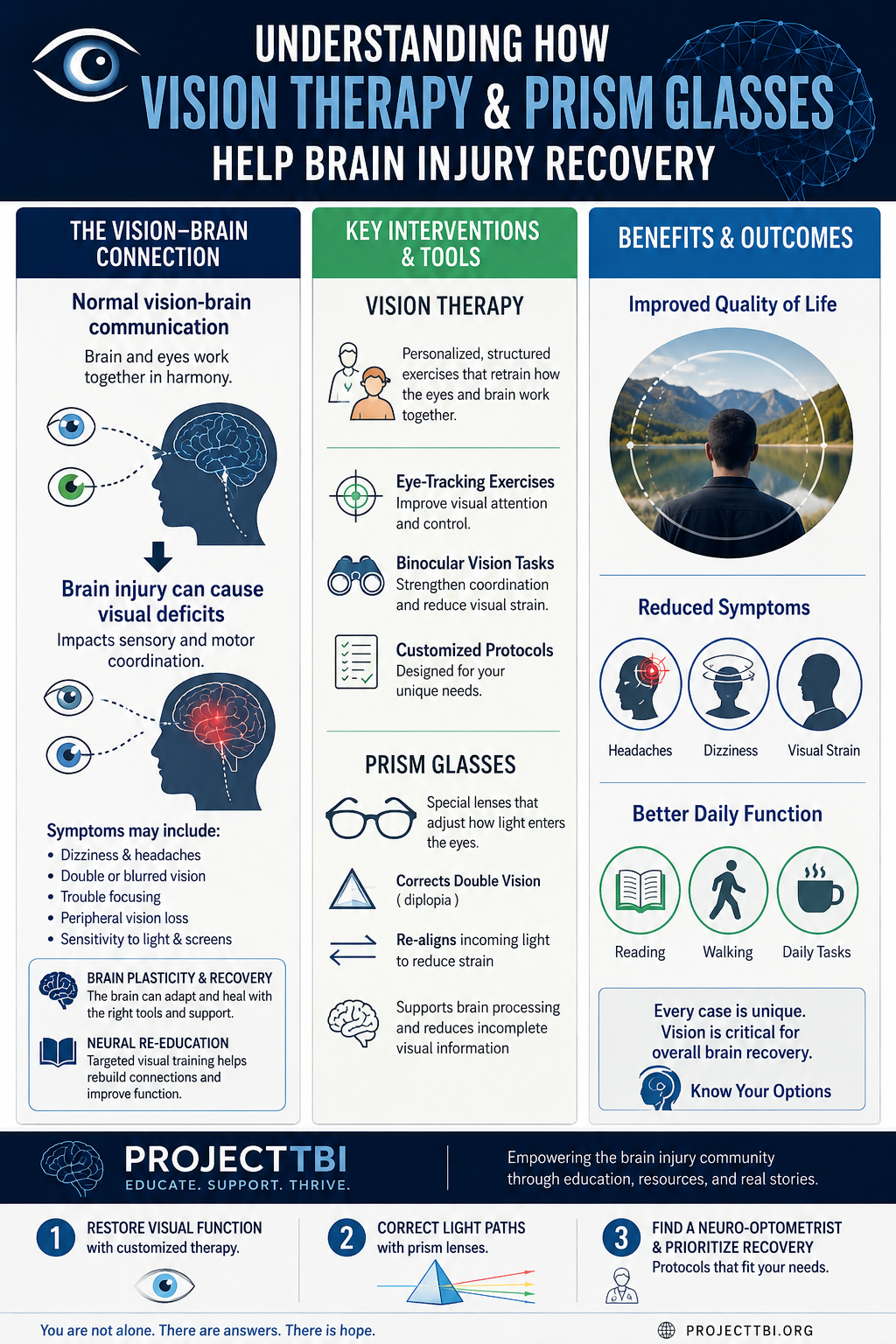
That sounds contradictory until you understand that vision isn’t just about the eyes. Your eyes collect information, but your brain has to interpret that information, coordinate the movement of both eyes, track objects, shift focus, judge space and motion, and combine two slightly different images into one stable picture.
After a traumatic brain injury, that system can get disrupted.
For some people, the result is obvious—double vision or blurred vision. For others, it can be much harder to recognize. Reading becomes exhausting. Words seem difficult to track across a page. Busy stores are overwhelming. Walking through crowds feels strange. Screens trigger headaches. Driving takes far more concentration than it used to. You may experience dizziness or visual fatigue without realizing that vision is contributing to the problem.
And sometimes a standard eye exam doesn’t tell the whole story.
Vision Therapy
Vision therapy is designed to work on the connection between the eyes and the brain, not simply eyesight.
Depending on the specific problem, therapy may involve eye-tracking exercises, focusing exercises, binocular vision activities, visual attention tasks, and other structured exercises intended to improve how the visual system processes information.
Think of it less like strengthening an eye muscle and more like retraining a neurological system.
That distinction matters after TBI.
What About Prism Glasses?
Prism lenses work differently.
Instead of changing the clarity of an image the way a traditional prescription does, prisms alter the path of light entering the eyes. In appropriate cases, this can help compensate for certain alignment or binocular-vision problems and reduce the effort required for the brain to combine visual information.
For someone whose injured brain is already spending enormous amounts of energy processing the world, reducing unnecessary visual workload can potentially make a meaningful difference.
But prism glasses aren’t a universal treatment for TBI, and vision therapy isn’t appropriate for every visual problem. The specific diagnosis matters.
That is why someone experiencing persistent visual symptoms after brain injury may benefit from an evaluation by a professional experienced in neuro-rehabilitation and post-brain-injury vision disorders, such as a neuro-optometrist or other appropriately trained eye-care specialist.
Pay Attention to the Symptoms
If you’ve had a brain injury and reading, screens, driving, stores, crowds, movement, or visually complicated environments suddenly require much more effort than they once did, don’t automatically assume you’re simply tired or “not concentrating hard enough.”
Your visual system may be working much harder than you realize.
Brain injury recovery isn’t only about what the brain can do. It’s also about understanding how much neurological effort it takes to do it.
Sometimes improving function begins with discovering where that effort is being spent.
Educate. Support. Thrive.
This article is for education and awareness and is not medical advice. Vision therapy and prism lenses should be considered based on an individualized evaluation by a qualified professional.